Home | Golf | "wu qiu" | mmm | Brainular |

Tuesday, January 20, 2009

R9 3.20.2009

Taylor Made really got my attention. Its R9, with FCT and MWT technology, 24 combination of adjustable face angle, lie angle, loft, draw and fade bias, wow.

A driver that transforms to any kind of adjustment with a ranch, wow. I already do all these different shots with one fixed face, lie, loft and weighting parameter with my current driver. Still, a driver that could adjust its lie angle? wow. Think about it, lie angle adjustment in driver. wow.


TM is also not advertising better distance or more superior performance, it is very careful in its advertising campaign. Though, it does say it allow 75 yards side to side variant with altering the adjustment above. wow, 75 yards.

Its website is awesome, promoting the driver with a launch date, wow.

Monday, November 10, 2008


Nakashima NX1 3W


Monday, October 27, 2008

the Hands

I am a slicer. I thought I was, but like the old asthma, ball slicing never go away. I may able to suppress the symptom, but it never disappears.

While the right side produces the source to power, control of ball flights, swing plane, it is the left hand (forward) that determines the direction, the ball spins, the follow-through.

Holding the left grip too tight, I would have exerted too much force on the whole left arm which will prevent the arms to fold in at the elbow, this would lead to an wide open arm-pit, if not a chicken-wing follow through.

Exerting too soft force on the left hand, the right hand may overpower the left side, causing a premature hand supination. Right arm will cross the left arm from above, leads to a closed face or a too flat follow through.

Bending forward on the left wrist may cause club face to increase in loft, shortening the distance if not a thinned or skulled shot.

Left hand and arm, is in the driver seat of my golf swing, which has been unfortunately put in a passive role all this time.

Monday, September 29, 2008

Hitting the Net

It was a rainy weekend, no golf. I went to the range, balls were wet, nets were wet, tees were wet, the range was sheltered, but after three days of rain, everything was soaked.

Met a guy, a guy I went golfing with at the range.

Meeting a friend at driving range is actually more fun talking than anything else. Talked about equipment, swing technique, etc, more like the whole universe of golf was upon us. No practicing, you don't practice at the range with a friend, you just don't. Anyway, in the fun of all the talk, we started testing out each other's clubs.

I drove one to the net. Since the net was wet, the water repelled from the vibration of the ball hitting the net. It was really a good scene, only that I could not capture it with photograph but words. Watching your driven ball repelling water from the net was one super cool experience, especially when there was a someone witnessing it. Well, the net was only 250 yds out, it was not super long drive, but still it was encouraging because how often do I get to see ball repelling water at the end of its trajectory, not vertically like from the pond but horizontally from the net?

Lately, people started asking me how do I drive a ball. To my surprise, people started listening to what I had to say. All this time, I had all these opinions about golf, no one listen or even question. All a sudden, somehow I hit the net one after another, people started to listen, even when I was bullshiting.

Guess what? I lost interest in experiencing my opinion.

Monday, June 23, 2008

Shots with side-spins

Lady A: "There is nothing more gorgeous than a man who hit a slightly draw driving shot"
Lady B: "That's right, it looks so cool"
Lady A: "I especially hates those men who slice, especially huge crooked slices"
Lady B: "Like he could not control his golf, kinda symbolize he is failing his career also"
Lady A: "Men that slice are ugly"
Lady B: "So is it!"

Quoted this from a conversation by two young ladies golfers... Is slice shot really that bad? For one, it is the most easiest to produce shots. For two, it is always there when you least need it and attracted to trees and water. For three, it is always a golfer dream to drive long and far, with slight draw as a plus. So why slice?
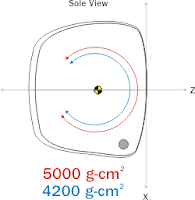
Nowadays the so called forgiving larger size, higher MOI, deeper COG driving head kinda intuitive to this fact. Firstly, the driver head is delivered with maximum MOI and higher COG, which means it is harder for the head to rotate. Secondly, with better material and manufacturing process, the face is "hotter" and sound is sharper at impact, leading a tendency to use more force for maximum swing speed. All these seems perfect for every golfer.

In the old days, with the smaller head, golfers used to be able to "shape" the shot better. The reason behind is less MOI allows the hands to supinate and driver face to open and close easier. The drawback is it requires tremendous accuracy in timing and skill to create those shots. To resolve the timing problem for regular John Doe, larger MOI and deeper COG is introduced; the head face is intended to maintain "square" constantly and launch the ball higher. Yet, most companies forget to mention the catch, if the golfer have a good swing and return the head squared to the ball, it is easier to launch a good shot. Yet, if the swing is questionable to begin with and not squared to the swing path, it is a lot easier to produce shots with side-spin. In order for the large MOI head to be really forgiving, the head have to be squared to the swing path, it is not much forgiveness after all.

In order to deliver the large MOI and deep COG head squared to the ball, swing nowadays require golfers to maintain the arms-triangle before and after the impact longer compare to the old days where it requires timing to rotate the club head during impact. The new triangle form requires tremendous body rotation (Michelle Wie, Tiger Woods, Anthony Kim, Adam Scott, etc). If there is any blockage or slow down in rotation, the head is not going to be squared. The larger head requires golfers to be physically stronger.

Occasionally, golfer will launch a shot that is long and far. The fined tuned sound from the new club heads allows golfers to differentiate between a good shot from a bad shot. The sound actually stimulates how good a good drive could be. Research has shown that audible sound represents more importance than visual sights in good golf shots. Unfortunately, an opened-face shot also sounds better in today's better manufactured golf clubs, it is louder "Ding" than muted "Dung" on central hit. Audio, could be the most misleading factor.

Realizing the fact that the face which sounds better could be opened, golfers usually tend to rush the club down in order to close the face. In the process of doing this, the swing speed is also increased. Problem is increasing swing speed for many does not equivalent to increasing ball speed. This is because the back-spin and side-spin are also increased due to mishit on the club face, or simply a premature release of force prior to impact.. To resolve this problem, most choose to use a lighter and stiffer shaft, in the same time reducing the loft of the club, hoping to reduce the ballooned ball flight.

With the combination of the above, golfers are usually chasing after the infamous cycle of the large MOI, deep COG, big sweet spot and light head weight golf clubs. In the end, golfers have a longer, stiffer, lighter shaft with a lower loft that produces sharp sound at impact head that is also high MOI, deep COG and large sweet spot. To complete all these, it is also paired with huge and fast swing. Yet half the shots are usually sliced to the right. Unfortunately it is just easier to swing the club as well as slicing the ball. Worst, compensating for going to the right side, many golfers pull it to the left by collapsing the left elbow and bending the wrist, resulting hook shots.

Consequently, there are two outcomes to this:
1. The golfer gets a bigger, lighter, deeper face with larger MOI, deeper COG and larger sweet spot to resolve all the problems above.
2. The golfer learn to swing it softer with less force, reduces the distance to maintain the accuracy. He later will adopt step 1 because the short distance is just not, err, satisfying.

This circular cycle of MOI, COG chase, can be easily found in any driving ranges or golf courses.

Wednesday, June 18, 2008

2008 US Open

I have been thinking, why was this past US Open championship such a big deal... Tiger was not playing at his best, thus whoever challenged him at their best is still lacking by a big gap comparing to the best at his top form.

So why is it so exciting? Enough to stir the media, the community to commend it as the best Open? Yeah, there was some circumstantial moments where the ball seemed to roll in for the sake of continuity of the game, but what the heck? In simply put, it was fun because the best had lowered his standard to good and he was more touchable, thus the competition was more enjoyable and more exciting?

What are the spectators' psychology behind? Emotion was moved because the best was more "reachable" now, they could feel the downfall of the best? Justification was leveled because the best was not so god-like anymore? or simply because of jealousy and feeling the sour-grape? or just like to watch the show because that was not something in concern in real life but something to talk about over a beer?

Personally, I like to see good become great. I like ultimate winning, I like dominance. I like the raw American absolute power. I like to see the best wins by a margin, the best is untouchable, unreachable by common folks. I like to see a human challenges the physical limit and break the rules set and reaches a level of unexpected, of unanticipated. All these mean something to me.

Whether it is a show or there is much competition now, it is a matter of sparking lights that go away quickly. I like to explore the universe, to break the boundary of what knowledge could bring us now. Tiger winning by margin kind of resembling this, whereas if there is another challenger to compete him and make the game more exciting, is immeasurably small. We are already living daily lives that are monotonous enough most the time, what is the point of watching something similar?

Tiger's shutdown for the year, is a disappointment to many, to me. The continuing of the legend, the boundary breaking fantasy, is once again put into the unknown territory.

Tuesday, June 03, 2008

Shaft Fitting

Knowing and looking at the wrong shaft measurements, that's one thing.
Knowing and fitting with the wrong shaft measurements, that's something.

For instance, if you are 180 lbs, you will likely choose a 75g shaft, with a regular 200g head + 50g grip, that gives you roughly 320g club at 45", a SW that's around D2/D3. Average people feel this is the most stable combination, meaning that you can drop the club in the "slot" and produce optimal club-speed. Some people with different weight, choose heavier or lighter club according to physical strength, and together with feel, this is where trial and error comes into picture. Though, you can only perform trial and error after you have a narrowed scope.

As general outline, flex could be fitted by swing speed, torque could be treated as a sign of forgiveness and release in timing, weight could be paired with strength, length could be adjusted according to height and finally swing weight and the shaft's characteristics, are varied by personalized preference. Noted that indicators like "tempo", "rhythm", "hitter or swinger", "1 or 2 axis swings", etc are normally not used as they are more a swing mechanism but has nothing to do with shaft fitting.

U.S is always an unique place where different circumstances allowed to happen, I meant those extreme scenarios beyond the norm. Only in U.S you will find shaft of 55g and X-stiff, take a look at other branded Japanese shafts, you will never find this combination. The argument behind is in order to go for extra distance, you sacrifice the stability for faster swing speed. This makes sense as U.S is a country of raw power. Though, do you perform better when you increase swing speed, do you hit longer or better? Normal understanding says you have to give up one to get the other. Yet, does increment in swing speed proportional to increment in distance?

The other view to look at this is, do you want shaft deforming for optimal performance? is deflecting in shaft shape a parameter to the swing's tempo, meaning that your tempo determine when to place the shaft back to the initial point that it bounds back and release all the energy on the ball?

So simply put, there are many measurements in shaft fitting to be considered, but fitting depends on how one prioritize the parameters grouped and chosen. (e.g. weight and length, then flex and torque, then SW). Usually the most charming fitting is the best distance under the controlled dispersion, providing that the golfer himself is assumed the fixed variable. An understanding view to this would be a sliding bar where left is swing speed and right is control, you choose the best fitting parameters available to move the slider horizontally along both ends, finding the optimal setting. Yet, you could never have both ends together.

Tuesday, May 27, 2008

Tried: OnOff Plus 2006

It is not like I could walk in to GolfSmith and pick up an OnOff driver and talk about it. It is such a rare incident that I could try an OnOff driver. The model tried was an old stock model, R flex, 10* degree and D0.5 balance.

The first impression, SMOOTH KICK : MP-606D shaft is felt stiffer than average regular flex. It felt tight, responsive and accelerating. It is a very good feeling that I hardly get from stock club. Shaft itself is impressive enough that if Daiwa allows its shafts to be sold separately, it will be a big hit. The quality of the head is beautifully constructed. Most importantly, the sound is crystal, in the audible range where it is not loud like FT-i and not sharp like Honma, but just nice.

Overall feedback on this club is really good. It is one of the rare circumstances where you like it much on the first trial.

Monday, May 19, 2008

Launch Angle / Spin Ratio

According to the Golf World this past week, Tiger Woods’ swing speed is around 124 mph, fastest among the tour professionals averaging at 110 mph. Tiger's ball speed is 189 mph, again, fastest among the pros at average of 164 mph, yet his launch angle is at 7.6* (average 11.2*) with back spin of 3144 rpm (average 2633 rpm). Tiger’s tee-off drive will create the ultimate impression of power driving where the ball dashing out like a bullet and climb higher gradually, then die out eventually.

According to the Analyst, Tiger's driving method is the third to the least efficient among tour pros, using high-launch / back-spin measuring ratio. In other words, the efficiency measured today is launching the ball optimally higher and reducing back spin significantly. Tiger's driving totally contradicts this concept while he could achieve 20 yds longer his 292 yds average distance, if he choose to launch the ball higher, argued the analyst.

Tiger's comment to Nike: build him a ball with highest back spin (Nike Platinum) so he could attack aggressively around the green (ever seen his ball back spinned from the bunker?) and it is his job to control the ball's launch angle.

Henrik Stenson, on the other hand, led the tour's most efficient launch/spin ratio with 311 yds drive. Anthony Kim, the new young tour pro, drive the ball 295 yds at the Chrysler championship, had ball distance-to-apex at 200 feet while the average range at 175 feet. Bubba Watson, again, another long hitter, ball speed at 182 mph and averaging over 300 yds drive launch the ball significantly higher.

Thus, besides focusing to create back spin off the bunker, it would be optimal to launch the ball higher, drive with least back spin and maybe possible to reach most par 5 in 2 from men’s tee.

Thursday, May 15, 2008

Impact Balance Point

Optimal Scenario 1

A normal rod with distributed static weight will have a balance point in the center of the rod.

When a load A is applied at one end with distance X to center, a same Load B at the other end with distance X to center will be needed to balance this rod.

This situation is under the condition where:
1. Load A = Load B
2.
Static weight is uniformly distributed across the rod

Scenario 2


In the case of a golf club, where static weight is not normally distributed across the club, there is shaft weight, grip weight and head weight.

Balance point of the club is usually at a point where it is closer to the club head. Measurement of swing weight inherits this concept to measure the balance of the club and express it in unit fulcrum.

In the actual usage of a golf club, we usually grip and apply force where Load B is. Under the off-center balance of the golf club, it is ideal that if Load A’ is where the counter force should be. However, with different set up of shaft, grip and head weight, it is very possible that an imaginative Load A extended outside of club head is where the real counter force is.

Load A will indicate that:
1. This golf club is not efficient; the full amount of Load B is not efficient transferred to Load A’
2. Feel of impact is less than ideal, where an ideal feel of impact at Load A’ will provide steady and balanced response.

How to measure distance X and X’ become a difficult challenge, and I will bet most of the OEM drivers sold in consumer market will not have Load A’ but Load A instead.