Shots with side-spinsLady A: "There is nothing more gorgeous than a man who hit a slightly draw driving shot"
Lady B: "That's right, it looks so cool"
Lady A: "I especially hates those men who slice, especially huge crooked slices"
Lady B: "Like he could not control his golf, kinda symbolize he is failing his career also"
Lady A: "Men that slice are ugly"
Lady B: "So is it!"
Quoted this from a conversation by two young ladies golfers... Is slice shot really that bad? For one, it is the most easiest to produce shots. For two, it is always there when you least need it and attracted to trees and water. For three, it is always a golfer dream to drive long and far, with slight draw as a plus. So why slice?
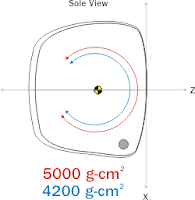
Nowadays the so called forgiving larger size, higher MOI, deeper COG driving head kinda intuitive to this fact. Firstly, the driver head is delivered with maximum MOI and higher COG, which means it is harder for the head to rotate. Secondly, with better material and manufacturing process, the face is "hotter" and sound is sharper at impact, leading a tendency to use more force for maximum swing speed. All these seems perfect for every golfer.
In the old days, with the smaller head, golfers used to be able to "shape" the shot better. The reason behind is less MOI allows the hands to supinate and driver face to open and close easier. The drawback is it requires tremendous accuracy in timing and skill to create those shots. To resolve the timing problem for regular John Doe, larger MOI and deeper COG is introduced; the head face is intended to maintain "square" constantly and launch the ball higher. Yet, most companies forget to mention the catch, if the golfer have a good swing and return the head squared to the ball, it is easier to launch a good shot. Yet, if the swing is questionable to begin with and not squared to the swing path, it is a lot easier to produce shots with side-spin. In order for the large MOI head to be really forgiving, the head have to be squared to the swing path, it is not much forgiveness after all.
In order to deliver the large MOI and deep COG head squared to the ball, swing nowadays require golfers to maintain the arms-triangle before and after the impact longer compare to the old days where it requires timing to rotate the club head during impact. The new triangle form requires tremendous body rotation (Michelle Wie, Tiger Woods, Anthony Kim, Adam Scott, etc). If there is any blockage or slow down in rotation, the head is not going to be squared. The larger head requires golfers to be physically stronger.
Occasionally, golfer will launch a shot that is long and far. The fined tuned sound from the new club heads allows golfers to differentiate between a good shot from a bad shot. The sound actually stimulates how good a good drive could be. Research has shown that audible sound represents more importance than visual sights in good golf shots. Unfortunately, an opened-face shot also sounds better in today's better manufactured golf clubs, it is louder "Ding" than muted "Dung" on central hit. Audio, could be the most misleading factor.
Realizing the fact that the face which sounds better could be

opened, golfers usually tend to rush the club down in order to close the face. In the process of doing this, the swing speed is also increased. Problem is increasing swing speed for many does not equivalent to increasing ball speed. This is because the back-spin and side-spin are also increased due to mishit on the club face, or simply a premature release of force prior to impact.. To resolve this problem, most choose to use a lighter and stiffer shaft, in the same time reducing the loft of the club, hoping to reduce the ballooned ball flight.
With the combination of the above, golfers are usually chasing after the infamous cycle of the large MOI, deep COG, big sweet spot and light head weight golf clubs. In the end, golfers have a longer, stiffer, lighter shaft with a lower loft that produces sharp sound at impact head that is also high MOI, deep COG and large sweet spot. To complete all these, it is also paired with huge and fast swing. Yet half the shots are usually sliced to the right. Unfortunately it is just easier to swing the club as well as slicing the ball. Worst, compensating for going to the right side, many golfers pull it to the left by collapsing the left elbow and bending the wrist, resulting hook shots.
Consequently, there are two outcomes to this:
1. The golfer gets a bigger, lighter, dee
per face with larger MOI, deeper COG and larger sweet spot to resolve all the problems above.
2. The golfer learn to swing it softer with less force, reduces the distance to maintain the accuracy. He later will adopt step 1 because the short distance is just not, err, satisfying.
This circular cycle of MOI, COG chase, can be easily found in any driving ranges or golf courses.


 Taylor Made really got my attention. Its R9, with FCT and MWT technology, 24 combination of adjustable face angle, lie angle, loft, draw and fade bias, wow.
 TM is also not advertising better distance or more superior performance, it is very careful in its advertising campaign. Though, it does say it allow 75 yards side to side variant with altering the adjustment above. wow, 75 yards.
 Nowadays the so called forgiving larger size, higher MOI, deeper COG driving head kinda intuitive to this fact. Firstly, the driver head is delivered with maximum MOI and higher COG, which means it is harder for the head to rotate. Secondly, with better material and manufacturing process, the face is "hotter" and sound is sharper at impact, leading a tendency to use more force for maximum swing speed. All these seems perfect for every golfer.
 opened, golfers usually tend to rush the club down in order to close the face. In the process of doing this, the swing speed is also increased. Problem is increasing swing speed for many does not equivalent to increasing ball speed. This is because the back-spin and side-spin are also increased due to mishit on the club face, or simply a premature release of force prior to impact.. To resolve this problem, most choose to use a lighter and stiffer shaft, in the same time reducing the loft of the club, hoping to reduce the ballooned ball flight.


